
• About

The Naked Theologian

~ A blog for stripped-down theology

The Naked Theologian

Monthly Archives: March 2011

#50 Is OCD the source of religion?

15 Tuesday Mar 2011

Posted by TheNakedTheologian in God, Philosophy of Religion, Religion, Theology

≈ 5 Comments

Tags

Desiderius Erasmus, Martin Luther, Protestant Reformation, Protestantism, Robert Sapolsky, source of religion
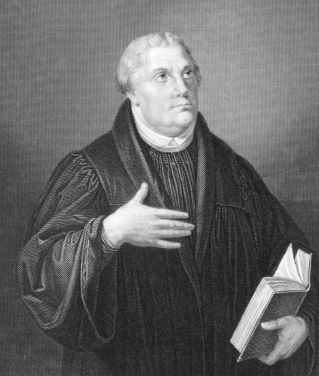
 

Martin Luther (1483 - 1546)

Martin Luther, the Father of Protestantism, had OCD.  So what?

Robert Sapolsky, the brilliant professor of biology and neuroscience at Stanford, has made his field accessible and entertaining.  But he admits that he sometimes steps beyond his area of expertise–for example, when he prognosticates on Martin Luther, and on the relationship between OCD and religion.  Sapolsky, it turns out, is no fan of Luther or of religion.

The mysterious title of Sapolsky’s essay, “Circling the Blanket around God,” expresses his view of the relationship between religion and OCD.  It refers to the “fixed action pattern” of the dog who, inexplicably, but nonetheless predictably, circles her blanket several times before finally plopping herself down for the night.  A human being suffering from OCD is like a dog circling, Sapolsky writes, except that s/he is unable to stop circling and continues, “exhausted and bewildered.”  Thus, the theistic individual—in Sapolsky’s view—circles the blanket around God, circling around and around, “exhausted and bewildered,” but unable to stop.

By his own admission, Sapolsky offers a single original idea in this essay—namely, the idea that OCD individuals started religious rituals.  Their attempts, he postulates, to reduce their anxiety by performing set rituals “somehow turns into rules for everyone else.”  Somehow.  Somehow?  Although this is an intriguing idea, it is most certainly not original but rather has preoccupied students of religion for some time.  Too bad that Sapolsky doesn’t ask the next, and most important question: what exactly is the mechanism whereby an individual suffering from OCD “somehow” turns his or her anxiety-reducing rituals into “rules for everyone else?”

As an example of a religious figure whose “anxiety-reducing rituals” became “rules for everyone else,” Sapolsky selects Martin Luther.  Luther started his theological career as an Augustinian monk but made his way up the academic ranks until he became a professor, among other things, of the Old Testament.  His distaste for indulgences (a payment paid to Church authorities to shorten one’s time in purgatory) led him to try to reform the Catholic Church.  Instead, he touched off the Protestant Reformation and permanently fractured Western Christianity into its two major families.  Luther, scholars agree, and Sapolsky observes, suffered from a bad case of “scrups,” or in everyday speech, from a terrible, OCD-induced, case of scruples.

Monks were expected to meet higher ethical standards than those that pertained to the lay population.  His religious order required that he set aside time for an examination of his soul; he was expected to identify every immoral behavior or idea.  No matter how petty the behavior or idea, he was to react to them with true sorrow, to repent with true contrition, and to ask God for forgiveness.  These steps were critically important; if not followed to the letter, Luther could not hope to be restored, by God, to a state of grace.  If he were to die unexpectedly, he would, because he was reprobate, be condemned to eternal damnation.

Luther was convinced that he had failed to repent for every single moral breach. Terrified for his soul, Luther sought relief from his OCD-exacerbated scruples.  Nothing worked.  Until he discovered a new way to understand the Bible and salvation.

By then, Luther had embarked on academic studies in theology and, having earned a Ph.D., he served as Doctor of Bible at the University of Wittenberg.  He became such an adept translator of Scripture that his translation of the Bible into German continues to be widely used today.  His painstaking study of Biblical texts eventually led him to develop a novel, but compelling, Scripture-based theology of “salvation by faith alone” (the basic tenet of what would become Protestantism).  Luther believed that, because of his faith in Christ, God would not punish him.

Okay, fine.  But how did Luther manage to convince so many non-OCD-sufferers to adopt his radical message?  By the early 1520s, he had attracted a vast and passionate following, and by the time of his death in 1546, people of all social classes sided with him and with his new creed.

Explanations for this abound.  Some point to the wide dissemination of Luther’s books and pamphlets thanks to the advent of the printing press, others ascribe Luther’s ascendance to the spiritual crisis that gripped Europe during the late Middle Ages or to the disgust engendered by the widespread corruption of the Church hierarchy.

Clearly, OCD or not, Luther managed to convince many other, rational, non-OCD individuals, to adopt his way of looking at the world, God, and human beings.
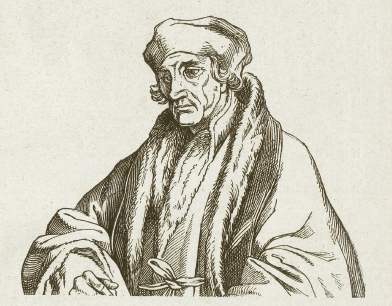
Desiderius Erasmus (1466 - 1536)

The key observation Sapolsky left out of his essay is this:  no novel theologies can succeed, including ones influenced by the OCD terrors of their authors, if they fail to be persuasive.  Luther and Lutheranism have persuaded, and continue to persuade a significant number of people.  Surely Sapolsky does not wish to impugn the intelligence of the political and religious leaders who took Luther and Lutheranism seriously.  The best minds of the era were conscripted by the Catholic Church to challenge Luther, including the highly esteemed Christian humanist Desiderius Erasmus.  Most scholars agree that, for all of his learning, Erasmus had met his intellectual match; his arguments failed to erode Luther’s theological claims in any significant way.  Other, different arguments would be needed.

To dismiss Luther’s theology because Luther suffered from OCD is a deplorable tactic.  There are better, more helpful ways to evaluate Luther’s theology.

Sapolsky’s is a cautionary tale of how data, even when it matches our own opinions, may deserve a second look.  Unless, of course, our own most cherished opinions are too fragile to survive being called into question or too fragile to survive comparisons to other opinions.  If this is the case then they ought not to survive.

Resource:  Robert Sapolsky, “Circling the Blanket for God,” in The Trouble with Testosterone, 241-288 (New York:  Simon & Schuster, 1997).
#49 Reporting to God for duty

07 Monday Mar 2011

Posted by TheNakedTheologian in Ethics, God, Philosophy of Religion, Religion, Theological Ethics, Theology

≈ 2 Comments

Tags

Corrie ten Boom, Desmond Tutu, Diana Butler Bass, Dorothy Day, Florence Nightingale, John Newman, Scott Walker, William Wilberforce

When it comes to religion, some of us want to have it both ways:  when deeply religious people do bad things, we are quick to say that their religious beliefs are to blame, but when deeply religious people do good things, we take little to no interest in their religious beliefs, as if those beliefs were irrelevant.

Example?  The recent belief.net blog-post, “God in Wisconsin:  Scott Walker’s Obedience” authored by the scholar of religion, Diana Butler Bass.

In her post, the politically-progressive Bass slams Wisconsin Governor Scott Walker’s brand of evangelical religion.  For her, the most disturbing part of his conservative Christianity is his no-wiggle-room obedience to God’s commands.  Bass points out that, for evangelicals like Walker, “Once you know God’s direction, no change is allowed.  Doubt opens the door to failure.  Obeying Christ’s plan is the only option.  In this theological universe, hard-headedness is a virtue, compromise is the work of the Devil, and anything that works to accomplish God’s plan is considered ethically justifiable.”

This, she notes, is the same sort of evangelical religion that shaped George W. Bush–and led to the wars in Afghanistan and Iraq.  She is of the opinion that President Bush’s obedience to God’s commands was the cause of the wars in Afghanistan and Iraq.

In spite of the ugh-producing situation of turning to someone like Walker or Bush to shed light on our own thinking, progressives, please take a deep breath (you may even need to swallow hard) and then ask yourselves this question:  is obedience really the problem here, or is the real problem the commands Walker or Bush claims to obey?  Because if Walker were obeying a different set of commands—say, God’s command that Wisconsin increase its minimum wage, would Bass (or you) object?  Or if Walker claimed to be obeying God’s command to work tirelessly on behalf of legislation to decrease the inequity between the richest and the poorest, would Bass (or you) object?

Most of us can name good people who have done good (defined here as progressive) things.  Yet, tsk tsk tsk, we rarely acknowledge their religious motives for doing that good.  Do we imagine that they were simply good people who would have done good things regardless of their religious beliefs?  Or is it simply that, because they did good things, their religious beliefs raise no red flags and so warrant no scrutiny?

But by overlooking the religious beliefs that motivate our heroes, are we ignoring some fundamental part of who they are?

Corrie ten Boom, raised in the Dutch Reform tradition, once said, “Don’t bother to give God instructions; just report for duty.”  For her, reporting for duty meant starting girls and boys’ clubs in her native Holland and eventually risking her life to hide Jewish refugees during WW II.  The risks were real; she was arrested but managed to survive Ravensbruck concentration camp.

And did you know that Florence Nightingale was a Christian universalist who believed that God wanted her to be a nurse?  In her journal, she wrote:  “God called me in the morning and asked me would I do good for him alone without reputation.”

Other religious do-gooders include Dorothy Day, John Newman, William Wilberforce, and Desmond Tutu.

Surely these report-to-God-for-duty folks would be troubled to learn that their religious commitment to serving others is being downplayed or ignored.  Surely they would be dismayed to discover that the force of their relationship with God is being excised from their biographies.

Though we may see ourselves as too autonomous or too agnostic to follow commands from God, we can learn something from the doggedness and zeal of those who report to God for duty.  Imagine for a moment that you believed, with as much conviction as a Scott Walker or a George W. Bush or a Corrie ten Boom or a Florence Nightingale that God commanded you to dedicate yourself to raising the average standard of living in the United States.  What if you could proclaim:  “Once I know God’s direction, no change is allowed.  Doubt opens the door to failure.  Obeying God’s plan is the only option.”

With a no-doubt, no-compromise, no-holds-barred, God-on-your-side-for-sure attitude, who knows what you might accomplish!  Would any effort seem too big, any policy-change impossible?

Maybe.  Maybe not.  Still, the point remains that disapprovers of the Walker and Bush brand of conservative religion can’t have it both ways when it comes to linking religious belief with good or bad actions.  Either religious conviction matters or it doesn’t.

If religion influences those with whom we disagree, then we have to allow that religion also influences those with whom we do agree.  To which Corrie ten Boom, Florence Nightingale, Dorothy Day, John Newman, William Wilberforce, Desmond Tutu, and many others would say amen.

The Naked Theologian

Unknown's avatar

Enter your email address to follow this blog and receive notifications of new posts by email.

Top Posts

  • #74 After the "Death of God," new gods?
  • #73 Will Her Methodist Faith Help HRC Make a Comeback?
  • #72 Trump's White Evangelical Voters: What Were They Thinking?

Recent Posts

  • #74 After the “Death of God,” new gods?
  • #73 Will Her Methodist Faith Help HRC Make a Comeback?
  • #72 Trump’s White Evangelical Voters: What Were They Thinking?

Recent Comments

Tulayhah's avatarTulayhah on #69 How To Read the Qur…
clinton's avatarclinton on #18 God and the Devil duke it…
marysedl's avatarmarysedl on #72 Trump’s White Evange…
DaCoot's avatarDaCoot on #11 What’s in a name? Go…
Home And Spirit's avatarHome And Spirit on #68 Suffering on Trial

Categories

Ethics God Philosophy of Religion Prayer Religion Religious Philosophy Spiritual Exercises Spirituality Theological Ethics Theology

Posts by Category

  • Ethics (15)
  • God (55)
  • Interpretation (1)
  • Philosophy (5)
  • Philosophy of Religion (27)
  • Philosophy of Religions (8)
  • Politics (1)
  • Prayer (11)
  • Religion (57)
  • Religious Philosophy (26)
  • Spiritual Exercises (9)
  • Spirituality (15)
  • Theological Ethics (26)
  • Theology (55)

Archives

Follow me on Twitter

My Tweets

Blog at WordPress.com.

Privacy & Cookies: This site uses cookies. By continuing to use this website, you agree to their use.
To find out more, including how to control cookies, see here: Cookie Policy
  • Subscribe Subscribed
    • The Naked Theologian
    • Join 67 other subscribers
    • Already have a WordPress.com account? Log in now.
    • The Naked Theologian
    • Subscribe Subscribed
    • Sign up
    • Log in
    • Report this content
    • View site in Reader
    • Manage subscriptions
    • Collapse this bar

Loading Comments...